
The Town of Halton Hills Public Works staff maintains safe routes of travel during winter to our over 1,000 km of roads and 160 km of maintained sidewalks. The town also clears Regional roads within Halton Hills. Operations are planned and executed in accordance with Provincial Minimum Maintenance Standards for Municipal Highways (O. Reg. 239/02).
While residents are not discouraged from calling to inquire when their road or sidewalk will be cleared, we do ask for your patience as we work through the clearing of roads and sidewalks.
On-street overnight parking is restricted annually from November 15 to April 15 the following year, between the hours of 2 and 6 a.m.
Uniform Traffic Control By-law No. 2023-0094
The overnight parking restriction applies to all streets under the jurisdiction of the Town of Halton Hills, unless authorized signs indicating otherwise are specifically posted.
Improper snow and ice clearing can be a serious hazard to motorists and pedestrians. Ensure your safety and the safety of others by avoiding parking on streets during snowstorms to assist Public Works staff with snow removal and winter control.
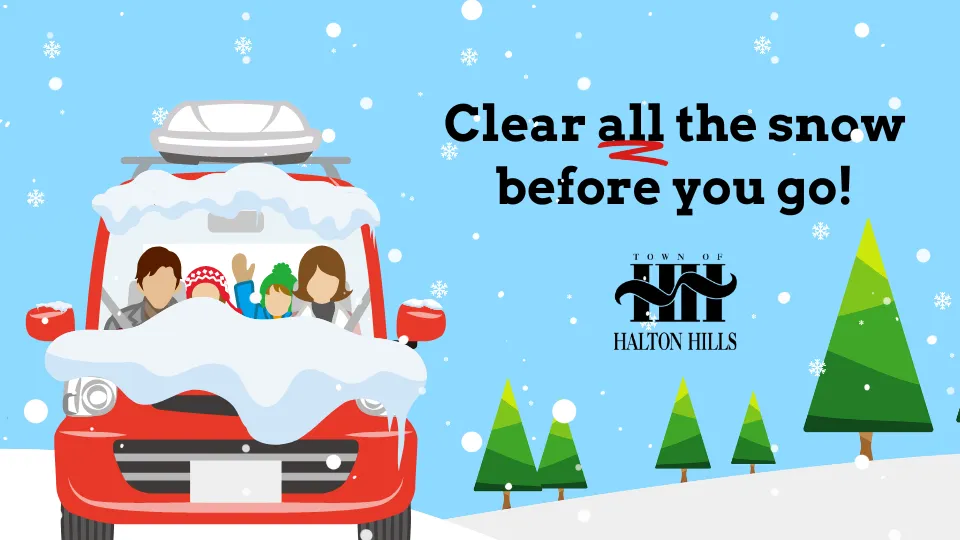 Note: Authorities may have vehicles ticketed or towed at the owners expense.
Contact Parking Enforcement at 905-873-2600, ext. 3030
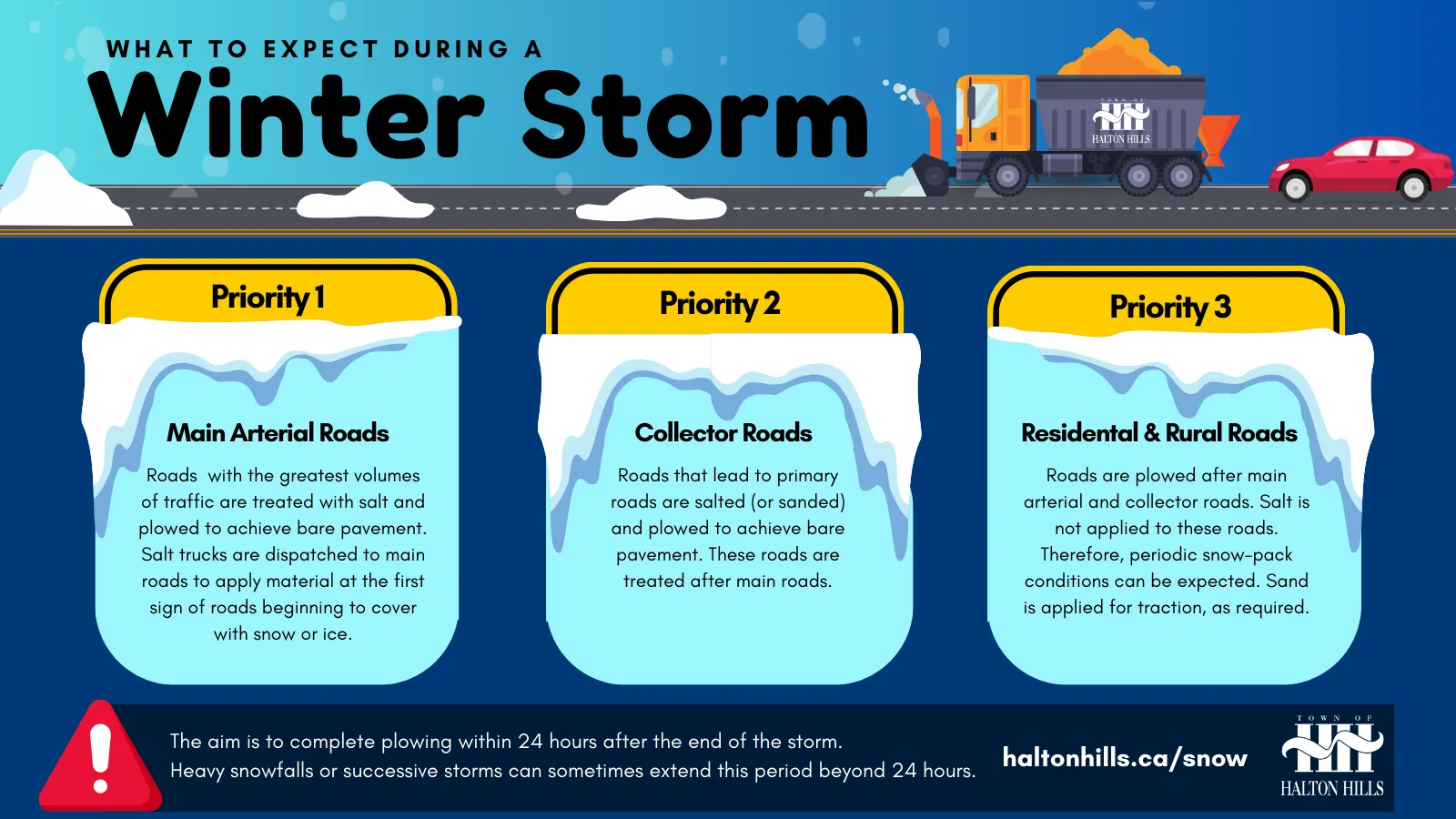
All roads are cleared after every major storm. When all streets need plowing, the aim is to complete plowing within 24 hours after the end of the storm. Heavy snowfalls or successive storms can sometimes extend this period beyond 24 hours.
.webp?language=en "Winter Storm - What to Expect TWFB (3)")
Priority 1 - Main arterial roads
Main roads, those with the greatest volumes of traffic, are treated with salt and plowed to achieve bare pavement. Salt trucks are dispatched to main roads to apply material at the first sign of roads beginning cover with snow or ice. In very cold temperatures, the effectiveness of salt is reduced, so occasionally sand may be used instead. When accumulations warrant, snow is plowed-off of main roads.
When conditions allow, a solution of salt brine will be applied to designated main roads in advance of snowfall. This helps to prevent snow and ice from bonding to the pavement, so plows can more easily clear the snow away and reduce the need for salt.
Examples:
- Georgetown
Mountainview Road
Guelph Street
Trafalgar Road
15 Sideroad
- Acton
Main Street
Mill Street
Priority 2 - Collector roads
Collector roads, or secondary roads that lead to primary roads are also salted (or sanded) and plowed to achieve bare pavement. These roads are treated after main roads.
Examples:
- Georgetown
Argyll Road
Danby Road
Delrex Boulevard
- Acton
Acton Boulevard
Tanners Drive
Priority 3 - Residential and rural roads
Residential and Rural roads are not salted to achieve bare pavement and periodic snowpack conditions can be expected. The plowing of Residential and Rural roads starts after main arterial and collector roads are cleared of snow and ice. Residential and Rural roads are sanded, as required, to provide traction. Sand is usually applied on hills, curves, and intersections when required. Continuous sanding will only be carried out during freezing rain or ice packed conditions.
Examples:
- Georgetown
Berton Boulevard
Weber Drive
Bowman Street
- Acton
Peel Street
Rosemary Drive
Tidey Avenue
- Rural
Fifth Line
Dublin Line
Abbitt Crescent
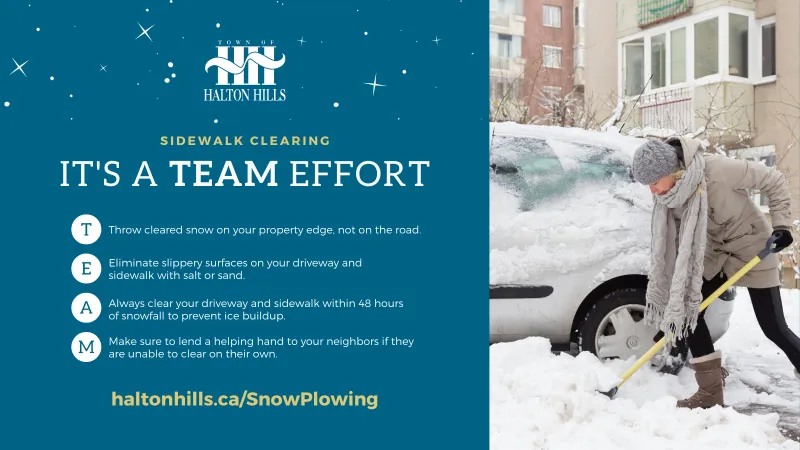 When sidewalks need plowing, the aim is to complete plowing within 24 - 48 hours after the end of the storm, depending on the amount of snowfall and successive storms.
Other than downtown areas, sidewalks are typically not salted to achieve bare pavement and periodic snowpack conditions can be expected. Sand is usually applied to sidewalks when required, and salt may be applied in ice conditions.
The Town maintains only designated sidewalks during winter. Approximately 160 km of sidewalks and pathways, or just over half of all the sidewalks and walkways in the community, are maintained. In order to preserve reasonable budgetary expense, By-law No. 2007-0003 provides the Council-approved criteria for the provision of snow clearing services and list of sidewalks receiving the service. The criteria includes sidewalks with traffic exceeding 1,000 vehicles/day (typically main roads and collector roads) and sidewalks adjacent to schools.
If a snow plow is stopped, keep back a minimum of 15 metres so the operator can see your vehicle.
Give snow plows plenty of room and do not pass.
Snow plows leave a pile of snow on your driveway when they pass. These are called windrows. To reduce the windrow in your driveway, clear snow towards the right side of the driveway (facing the street).
Do not let children climb snowbanks as they could slip off into the path of oncoming traffic.
Do not let children form tunnels into snowbanks as the snow may collapse or be pushed down by plow equipment during clearing operations.
Please check that catch basins, culverts and fire hydrants are not blocked. This will ensure proper drainage when snow melts, and will provide fire fighters with a clear path to the hydrant in case of emergency.
Do not place or push snow or ice onto roadways. This is against the Town's Highway Encumbrance By-law No. 2019-0008, and Fouling and Encumbering of Public Roads By-law 2006-0054, and will result in a fine.
.webp?language=en "Impacts of Salt on the Community (1)") A Salty Situation - Protecting Our Water in Halton Hills
A Salty Situation - Protecting Our Water in Halton Hills
While road salt continues to be an effective and economical winter maintenance product, it also has undesirable effects. These include damage to infrastructure and vehicles, environmental impacts on land and water, and potential impacts to ground water. By practicing 'Salting Responsibly,' we can ensure the safety of our roads, walkways, and parking lots while also mitigating impacts to our environment and drinking water sources.
Environment and Climate Change Canada (ECCC) released a “Code of Practice for the Environmental Management of Road Salts” (Environment and Climate Change Canada, 2004). As part of the Code of Practice, Halton Hills maintains a Salt Management Plan (SMP) and reports status annually.
The Clean Water Act, 2006 was established to guarantee clean, safe, and sustainable drinking water for Ontarians by safeguarding sources of municipal drinking water, such as lakes, rivers, and wells. Source Protection Plans (SPPs) include policies that suggest or mandate actions to mitigate activities identified as threats to drinking water. Halton Hills is part of three Source Protection Regions, each with SPPs approved by the Ministry of the Environment and Climate Change.
Through its Salt Management Plan, the Town adheres to best practices, including:
Direct Liquid Application
What is it?
- Application of a brine solution directly on the roads surface.
- Brine is applied to designated roads in advance of a winter event, and when conditions are favourable.
* Salt Brine: A 23.3% sodium chloride solution.
Why we do this?
Prevents the accumulation of black ice, frost, and packed snow.
Helps to prevent snow from bonding to pavement.
Tips on How to Salt Responsibly Around Your Property
Road salt works well to melt ice and snow around your property but it also has long-term impacts on the environment. Check out these tips to clear your driveways, walkways and sidewalks and keep safe while using less salt!
Shovel or plow snow before applying salt. Salt will not work to melt the snow.
Spread salt sparingly and evenly, but remember, a little goes a long way! Using more salt won't yield better results. If you see salt left on the ground after the snow and ice clears, you are using too much. A few tablespoons of salt for a one-metre square area should do the trick.
Use alternative products to salt such as, grit, sand, or non-clumping kitty litter to help create traction.
Keep storm drains clear to help melting snow drain away from your property.
- Ensure your salt is contained in a proper container with a lid to prevent rain and snow from entering.
FAQ's
To report a snow related concern, please call Public Works at 905-873-2600 x2603.
The Town of Halton Hills priority for plowing is to first clear all arterial and collector roads before clearing the residential streets. When all streets need plowing, the aim is to complete plowing within 24 hours after the end of the storm. Heavy snowfalls or successive storms can sometimes extend this period beyond 24 hours.
The Town's Sidewalk Snow Clearing By-law sets out the streets where the Town clears the snow and ice from over 160 km of sidewalks on arterial and collector roads and streets with schools. The Town of Halton Hills Property Standards By-law 2008-0137 states that property owners of multi-residential, commercial, industrial and institutional properties are required to clear snow and ice from sidewalks on their property.
Such action is prohibited by the Town's Obstruction Encumbering and fouling of the Highways By-law 90-68. Improper snow and ice cleaning can be a serious hazard to motorists and pedestrians. Community Standards 905-873-2600 ext. 2330
It is the Town's responsibility to push the snow to the side of the road and create a clear path for vehicular traffic. To reduce the amount of snow in your driveway, clear snow toward the right side of your driveway (facing the street). This will reduce the amount of windrow left at the end of your driveway.
To achieve bare pavement, salt must be applied at the onset of snow so that a layer of salt brine is maintained between the road surface and accumulating snow (to prevent bonding). In order to provide this level of service to residential roads, significant increases in equipment and salt would be required, with increased costs and environmental impact. The town as well as other Canadian road agencies are required to have a Salt Management Plan to manage salt use and minimize environmental impacts. It would be unusual for a municipality subject to winter climate conditions, such as Halton Hills, to consider a snow packed road surface as unacceptable for local residential roads.
If there is a concern that an intersection needs to be cleared due to obstruction of view, please notify Public Works, and the work will be scheduled after the snow removal areas are completed.
The Town does not clear snow around a fire hydrant. Surrounding neighbours are asked to assist in keeping fire hydrants clear.
The Town does not have a snow clearing program for seniors. However, seniors and persons with disabilities who cannot arrange their own service provider can call Links to Care at 905-873-6502 in Georgetown, or 519-853-3310 in Acton, who will look for a contractor to remove snow at the resident's expense.
Yes, notify Public Works. Once a call is received, a Request for Service is made up, and staff will schedule the repair or replacement.
Yes, notify Public Works. In the spring, Town staff will topsoil and seed areas where the plow has caused damage. However, it is the homeowner's responsibility to care for the area, once it has been seeded.