

Why Invasive Species Matter
- Displace native plants and wildlife
- Damage natural habitats and ecosystems
- Impact parks, trails and green spaces
- Increase maintenance and environmental management needs
Common Invasive Species
- Invasive plants that spread quickly and outcompete native vegetation
- Species that affect trees and natural areas
- Aquatic or terrestrial species that impact ecosystems
What You Can Do
- Avoid planting or spreading invasive species
- Use native or non‑invasive plants in landscaping
- Clean equipment, footwear and vehicles when moving between natural areas
On Your Property
- Monitor your property for invasive plants or species
- Remove invasive plants safely where possible
- Follow recommended disposal methods
For tree-related impacts:
In Parks & Natural Areas
- Stay on designated trails
- Do not remove or relocate plants or wildlife
- Report concerns to the Town when issues are identified
Reporting Invasive Species
If you notice invasive species on Town property or in public spaces, you can report it for review.
Town’s Role
- Monitor invasive species in parks and public spaces
- Manage impacts where feasible
- Support education and awareness
What is it?
An invasive plant.
The sap of Giant Hogweed can negatively affect human health.
Can be found along roadsides, vacant lots and stream banks.
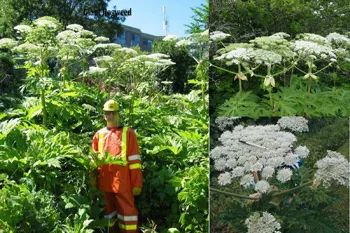
Symptoms caused by Giant Hogweed sap
Serious skin inflammation (photodermatitis).
The skin to be highly sensitive to UV rays due to a chemical called furanocoumarins.
Skin blisters, redness, scarring, and other discolouration that can last for years.
Temporary or permanent blindness if sap enters the eyes.
Reactions that can occur for up to 48 hours after contact.
Heat and moisture (sweat) can enhance the reaction.
What does it look like?
Height
- 1 to 4 metres (3 to 14 feet)
Flower
Large white clusters of small flowers
Umbrella shaped
30 to 60 cm in diameter (1 to 2 feet)
Leaves
Up to 1 metre (3 feet) in diameter
Sharp coarse teeth
Compound leaves deeply divided into lobed toothed leaflets
Produces watery sap
Stem
Rough and bumpy
Course white hairs emerging from bumps
Hollow
Purple/red splotches
How can I be exposed to the sap of Giant Hogweed?
Touching or brushing up against the plant.
Touching clothing or pets that have come into contact with the plant.
The sap can become airborne by pulling, cutting or mowing giant hogweed. This can cause sap to get in the eyes.
What do I do if I accidentally come into contact with Giant Hogweed?
Wash the affected area immediately with soap and water.
Keep the affected area out of the sun for at least 48 hours.
Seek medical attention.
What do we do?
Inspect locations
Control and treat hogweed with pesticides as permitted by Community Standards By-law 2008-0138
If you find giant hogweed on municipal property please contact Public Works at 905-873-2600, ext. 2603.
If you suspect Giant Hogweed is on your property
DO NOT TOUCH! Keep children and pets away from the area.
You are encouraged to contact a licensed weed exterminator. They can be found under “Weed Control Services” in the Yellow Pages. If you choose to remove giant hogweed yourself, USE EXTREME CARE. Information on Giant Hogweed removal methods and how to report a sighting can be found at Ontario Invasive Plant Council.
DO NOT compost the plants.
DO NOT place out for curbside collection either as Leaf & Yard Waste, Green Cart or waste material.
Giant hogweed must be taken to the Halton Waste Management Site for safe disposal.
Monitor the area for future growth.
Community Standards By-law 2008-0138 Part 3, Section 8 Nuisance Weeds states "Property Owners are required to destroy and remove all nuisance weeds and weed seeds on their land."
Additional Resources
Outbreaks of spongy moths are cyclical and typically peak every 7 to 10 years. Currently, spongy moths are on a downward trend from the peak in 2021.
Most of the trees in Halton Hills are on private land. During an outbreak, property owners can help reduce the impact on the community’s tree canopy by reducing spongy moths on their property. If you’re concerned about the trees on your property, you can try the methods listed below or consult a local tree service company. Control methods are linked to the spongy moth’s stage of development.
Watch the free information webinar on spongy moths hosted by the Toronto and Region Conservation Authority in partnership with Credit Valley Conservation. Viewers will learn about the spongy moth life cycle, how to identify them, and what actions you can take to minimize their impact on trees.
August to early May: remove and destroy egg masses
Egg masses can contain 300 spongy moth eggs! Destroy the egg masses to reduce the number of caterpillars that emerge in the spring.
Check for spongy moth eggs on tree trunks, branches, building structures, and objects around the home.
Scrape off egg masses. If they fall to the ground, crush them with your shoe.
Place collected egg masses in soapy water for a few days. Afterwards, discard them in the garbage.
May to July: hand picking caterpillars
Scrape off caterpillars into a bucket of water/soap mixture. Put a lid on the bucket, leave it for a few days to kill the caterpillars then dispose them into the garbage. Do not scrape caterpillars onto the ground. If caterpillars fall to the ground, crush them with your shoe.
Wear gloves when handling caterpillars to avoid skin irritations or allergies.
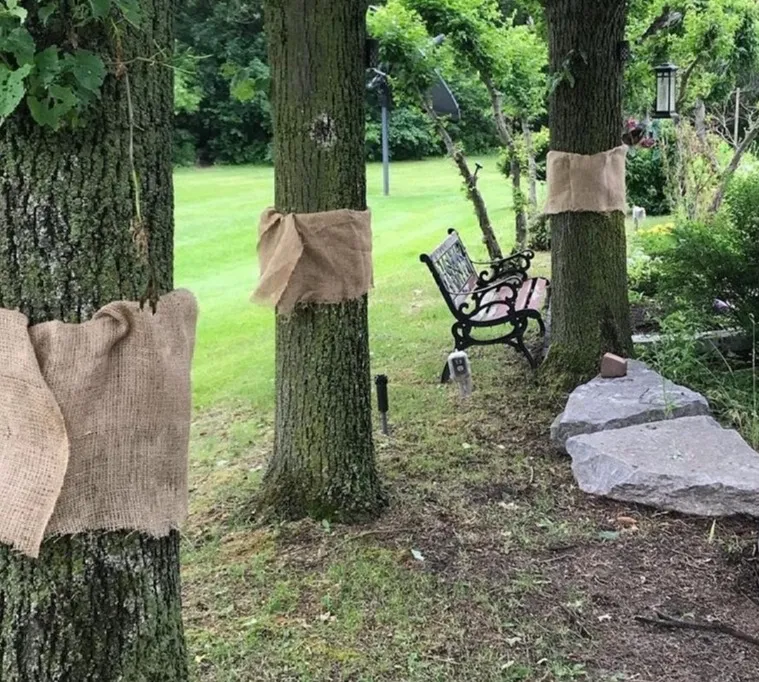
June to August: burlap bands on tree trunks
To trap caterpillars, wrap a piece of burlap one meter wide around the tree trunk and tie a rope around the middle of it. Fold the burlap over. Caterpillars crawl down the tree trunk during the day. They climb back up the tree trunk in the evening, as they try to climb the burlap, they will get trapped under it.
Lift the burlap fold around 6 p.m. each day to see if any caterpillars are under it. Scrap all caterpillars into a bucket of soapy water, place a lid over the bucket for a few days to kill them and then throw them out in the garbage.
Wear protective gloves to prevent irritation or an allergic reaction from Caterpillar hairs.
July to end of August: pheromone moth traps
Pheromone moth traps catch male spongy moths so they cannot reproduce. Traps are available to purchase at a local garden centre or online). Traps should be hung from a tree or placed on a stand approximately 4 to 5 feet from the ground.
- Dispose traps in the garbage.
Additional Resources
What is it?
Invasive and highly destructive insect.
Attacks and kills all Ash trees native to North America.
Brought to Canada unintentionally through wooden packing crates from Asia in the early 1990s.
Identified as an invasive alien species by the Canadian Food Inspection Agency (CFIA) for Halton in 2009.
Has the potential to eliminate ALL of our Ash trees (5 to 10% of our urban forest*).
A large section of Ontario and Quebec is under quarantine.
Movement of ash wood products outside of the regulated area is prohibited (Map of Areas Regulated for the Emerald Ash Borer).
*An urban forest refers to all of the collective varieties of trees that we have growing on our streets
Signs of Emerald Ash Borer
Bark damage – vertical cracks in the bark
Discolouration or yellowing of leaves
D-shaped holes on bark and branches
Crown dieback - loss of leaves in the tree canopy
Shoots growing from trunk and branches of the tree
Increased presence of woodpeckers feeding
Municipal Ash Tree Management
The remaining street Ash trees can be considered “standing dead” as they will all succumb to the EAB over the next few years and the trees will be removed and replaced as time and budget allows. See the "Emerald Ash Borer Management Strategy" Council Report 2012-0034 from October 15, 2012, for more information.
If you suspect EAB on a tree located on Town property, please contact Public Works at 905-873-2600 Ext. 2603 to request service. If you suspect a tree on your property is infested, or are interested in treating a tree on your property, please call a certified arborist for more information.