

Residents with drainage concerns are encouraged to contact Public Works to arrange for staff to investigate a potential problem area. This includes but is not limited to blocked culverts, damaged headwall/culvert ends, plugged ditches and more.
What is a catch basin?
A drain, usually found at the sides of roads, in ditches and within your home's rear yard area;
Designed to receive rain and ground water from roadways, ditches and parking lots. Water is then transferred through piping to the storm sewer, nearby water course or a stormwater management facility.
What we do
Replace and repair damaged catch basins.
Provide maintenance to catch basins that are plugged with debris.
Remove leaves, snow, ice and debris blocking catch basins.
Do not pour household liquids into catch basins, as they are not filtered and lead directly into our local streams and rivers.
What is a culvert?
- A culvert is a tunnel or pipe under a driveway, road or railway.
They are connection points between ditches, storm sewers, water courses and/or a storm water management facility.
- They carry water from ditches to storm sewers and/or retention ponds.
They provide a driveway entrance across an existing ditch for new constructions, new driveways, or new access points.
- Driveway culverts are the responsibility of the property owner
What we do
Install culverts at the property owner’s expense (Transportation and Public Works User Fees)
Replace damaged culverts.
Provide maintenance to culverts that are plugged with debris, heaved up, caved in, or frozen (causing flooding).
If a property owner chooses to pave their driveway, the Town will not be responsible for replacing pavement in the event that a repair or replacement of the culvert is required due to frost heaving or as a result of construction.
What can you do?
Remove leaves and other debris as they accumulate.
Regularly mow the grass in the ditch.
Avoid altering the ditch, culvert, or drainage system in any way (altering grading, yard slopes, or obstructions).
Consider having a representative from Public Works check the condition of the culvert prior to repaving your driveway.
Do not pour household liquids into culverts, as they are not filtered and lead directly into our local streams and rivers.
Additional information
Property owners do not have the absolute right to outlet to roadside ditches.
The Town reserves the right to remove or restrict any outlets to ditches that cause operational issues or damage to the drainage system.
If you need to direct water to the Town’s ditches, it is recommended that you contact Public Works before proceeding.
Apply for culvert installation or replacement
For more information, contact the Transportation and Public Works Department. Contact Us
Residents will require a copy of their property survey showing their existing driveway width and proposed changes.
What is a ditch?
Overland drainage swales along the sides of roadways are specifically meant to drain excess water from roads.
Holds water and controls how fast the water enters the drainage system (storm sewers and ponds).
Some ditches allow water to flow into the groundwater table.
During winter, snow plows push snow into ditches. They are therefore used as snow storage areas.
What we do
Maintain roadside ditches.
Monitor the drainage efficiency of ditches.
Additional information
Property owners do not have the absolute right to outlet to roadside ditches.
The Town reserves the right to remove or restrict any outlets to ditches that cause operational issues or damage to the drainage system.
If you need to direct water to the Town’s ditches, it is recommended that you contact the Public Works Division before proceeding.
Do not pour household liquids into ditches as they are not filtered and lead directly into our local streams, rivers, or groundwater.
What is a stormwater management facility?
Stormwater management facilities are designed to retain water runoff and slowly release it back into receiving water courses, helping to mitigate downstream flooding and removing most pollutants in the process. During significant rainfall and melting events, permeable surfaces (soil, grass, gravel, etc.) infiltrate a portion of runoff however, urbanization and development increases the amount of non-permeable surfaces (roads, driveways, sidewalks, etc.) which reduces water infiltration. This increases the risks of flooding, large puddles, erosion of our lands and water in unwanted places.
In order to decrease these risks, water runoff is directed into our Town’s drainage system through catch basins, culverts, ditches, swales and drains which lead into storm sewers. From there, the water runoff is directed into stormwater management facilities.
Note: Storm sewers DO NOT collect sewage from homes or businesses.
Safety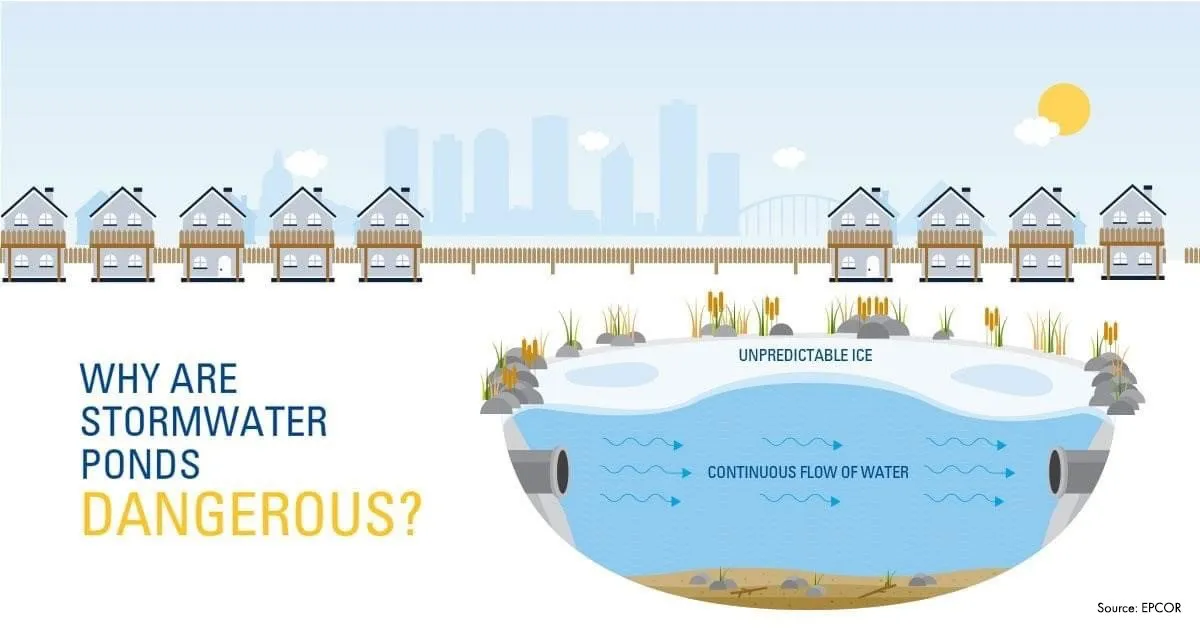
Recreation of any type is not permitted in stormwater management facilities as they are not safe:
-
Submerged inlet and outlet pipes have continuously flowing water beneath the surface whether frozen or open.
-
Conditions can change rapidly, including fluctuating water levels and varied ice thickness. Facilities can be especially volatile in the spring when rainfall, warmer temperatures and melting ice/snow is common.
-
Ice surface varies in depth across the surface, appearing thick in some areas while others may have little to no ice.
-
Pollutants in the stormwater facility (such as road salt) can also impact ice quality and make thickness highly unpredictable and inconsistent.
-
Snow often obscures holes in inconsistent ice and the ice may lack visible indications of unsafe conditions.
Trespassing on stormwater management facilities is subject to a maximum fine of $10,000 by order of the Trespass to Property Act, R.S.O 1990, c. T.21.
Check out a message from local Fire Departments, including Halton Hill's former Fire Chief Jon Rehill.
What we do
The Town's Transportation and Public Works department is responsible for all stormwater management facility maintenance. This includes:
-
Maintenance of structures such as headwalls, pipes, gates and valves.
-
Maintenance of plants and vegetation.
-
Removal of litter and debris.
-
Monitoring of pond and sediment level.
-
Removal of sediments.
-
Maintenance to pond banks (erosion prevention).
-
Pond drainage.
What can you do?
There are many actions residents can take to help our stormwater management facilities function properly.
-
Dispose of trash, grass clippings and leaves properly to keep out of the Town's drainage systems.
-
Minimize use of chemicals on your property such as fertilizers and pesticides.
-
Obey all signage posted around facilities.
-
Avoid disturbing vegetation around facilities to minimize sediment runoff.
-
Please DO NOT plant any vegetation of your own, as these will be considered invasive threats to the ecology and drainage patterns of the pond. Specific vegetation is planted in and around stormwater management facilities that allows for proper drainage and fits into local ecology for that area.
-
Please DO NOT introduce any animals to the pond (birds, fish, frogs…etc.), as these are also considered invasive species and threaten the ecology of the area.
The Town of Halton Hills recently completed the Stormwater Management Strategy which has led to the Town undertaking a Stormwater Management Master Plan.
There have been an increasing number of locally extreme rainfall events with much higher intensities than those seen in the past, earlier snowmelt, and increased flood risks which pose challenges to the existing infrastructure.
As the Town grows, and weather changes, the way in which precipitation run-off can move through the landscape becomes more important and challenging. Stormwater systems exist throughout our community to maneuver rainfall and other collected water to collection basins and away from our residences.
Glossary of terms
| Term | Definition |
|---|---|
Catch basin | Stop debris and collect rainwater from the road which is distributed into storm sewers. The rainwater then travels through an outfall where the water is reintroduced safely into the environment. |
| Culverts | Relatively short sections of drainage pipe that allow water to flow under roads, railway, trails, etc. The Town commonly uses pipes made from High Density Polyethylene (HDPE), Corrugated Steel Pipes (CSP) or Poly Vinyl Chloride (PVC). |
| Ditch inlets | Concrete inlets in the ground alongside a road or ditch to facilitate drainage and stop debris. |
| Maintenance Holes | Allow an authorized person access into the storm sewers for inspection and cleaning. |
| Storm sewers | Sewer pipes, usually underground, used to carry off snow melt and rain water. |
Stormwater maintenance facility | Artificial bodies of water designed to collect and retain stormwater (rain and snow/ice melt), reduce potential flooding and also retain sediments and other materials. The function of stormwater maintenance facilities is to contain water and release it slowly. |
For local examples of stormwater management facilities, please view the map.