

Normal urban coyote behaviour
Active during all seasons, day and night.
Watching or following you and your dog from a comfortable distance – coyotes are very curious.
Sitting or walking somewhere in plain view (parks, roadsides, neighbourhoods) either alone or with other coyotes.
Hesitating and looking back when you’re trying to scare it away. Keep scaring the coyote until it leaves.
Yipping and howling.
Coyote behaviour and your dog
Most interactions with coyotes in Halton Hills are the result of a nearby, regular food source or the presence of a dog. Coyotes can behave in a defensive manner around dogs which is often interpreted as aggression. These negative interactions between dogs and coyotes are usually caused by bold behaviour from the dog. Coyotes are naturally timid, but will defend their territory and their pack.
Report coyote sightings:
Residents are encouraged to report coyote sightings to the Town by contacting Service Halton Hills at [email protected] or by calling 905-873-2600.
Take an e-learning course on Coyotes in the Urban Landscape to learn basic facts about coyote behaviour and how both animals and people can remain safe. This informational module has been created in partnership with Coyote Watch Canada.
Coyotes are naturally timid and will flee when confronted assertively. The following actions teach coyotes to maintain normal boundaries from humans:
Be Big: Make yourself appear large, imposing or as threatening as you can. For example, stand up if possible, raise your arms and wave them or an article of clothing in the air.
Be Loud: Making loud sounds or noises can help to scare a coyote away. Blow a whistle, stomp your feet, clap your hands, and yell “go away coyote” to alert people nearby.
Be Threatening: Display assertive behaviour to scare the coyote away. For example, swing your walking stick or cane, shine a flashlight on the coyote, throw a tennis ball or a small pebble or stick in their direction. NEVER hit or injure a coyote with an object.
If a coyote poses an immediate threat or danger to public safety - call 911.
Allow your dog off leash only in designated leash-free parks.
Walk your dog in areas of high pedestrian traffic such as busy streets, jogging and park trails, keeping your dog on leash and under your control at all times.
Walk during daylight hours.
Avoid walking along abandoned properties or densely forested areas.
Keep your dog in sight, avoid using an extendable/flexi leash.
Clean up after your dog – coyotes are attracted to dog feces.
Spay and neuter your dogs – coyotes are attracted to, and can mate with, domestic dogs that have not been spayed or neutered.
Encourage the coyote to keep moving by shouting and gesturing assertively, remember Be Big, Be Loud, Be Threatening.
NEVER feed a coyote. Deliberate feeding of coyotes is irresponsible and allows them to adapt more easily to living and foraging for food around houses and yards.
Make your home unwelcoming and protect your pets:
Remove long grass, dead brush and wood piles from your property and ensure gaps around and under decks and sheds are closed off. These conditions provide potential den sites for coyotes or other wild animals that attract coyotes.
Use motion sensor lights.
Remove all water and food sources from your yard, including birdseed and ripe/rotted fruit that has fallen to the ground.
Store garbage, compost and pet food in a place wildlife cannot access. Move your bins to the curb the morning of pick up instead of the night before.
Keep cats indoors or supervised when outside.
Avoid feeding pets outdoors as the smell of the food may attract coyotes or the animals they hunt.
Always monitor your pets when outdoors. If coyotes are in your area, do not let you pet out into your backyard alone.
Protect your Livestock:
Where possible, bring your livestock into barns at night.
Use guard animals such as donkeys, llamas, and dogs.
If livestock has been killed by predators you may be eligible for compensation through the Ontario Wildlife Damage Compensation Program.
Contact a local officer from the Ministry of Natural Resources and Forestry
When coyotes get too close
Do not run; back away slowly while maintaining eye contact.
If you have your dog with you, ensure they are leashed and behind you. If you have a small dog or small children with you, pick them up.
Continue to use the aversion techniques listed above
If the coyote doesn't leave, you may be near its den or food source. Leave immediately and consider changing your route for a few weeks. If the coyote is denning in the area, they will likely move on after some time.
Understanding Coyotes
Halton Hills is a terrific blend of urban and rural areas. As a result, wildlife occasionally can be spotted in developed parts of our community with coyotes being one of the most common sightings. Understanding coyotes is an important step in knowing how to react when you encounter one.
Coyotes tend to be more visible during the spring/early summer – more sightings, more interactions with dogs, more shadowing (or following) of people. The reason for the increased visibility is due to denning and pupping season, the time of year when coyotes are both more active around and protective of their den sites.
Coyote dens
While hazing usually works to frighten off a coyote, it is not recommended to conduct hazing near denning areas, adults with pups, or when a coyote is eating or has food. If a coyote seems intent on defending a certain area, particularly around pupping season, your best bet may be to alter your route to avoid conflict with a normally calm animal.
Coyotes may be more visible in the winter. Vocalizations in the form of yipping and howling may become more common during this time as they communicate with one another as they seek a mate.
Capture and relocation of coyotes more than one kilometre away is not permitted under Ontario's Fish and Wildlife Conservation Act. Research shows wildlife relocated from urban areas usually return or become a problem elsewhere.
In addition, when coyotes are hunted or lethally destroyed, remaining ones compensate by producing larger litters and expanding their range. Only in rare cases where an individual coyote is demonstrating unusual or aggressive behaviour or severe trauma or illness do animal control agencies attempt to capture coyotes.
If a coyote poses an immediate threat to safety, call 911.
If you encounter a coyote you believe to be sick or injured, contact Omega Canine Control Services at 905-877-6235.
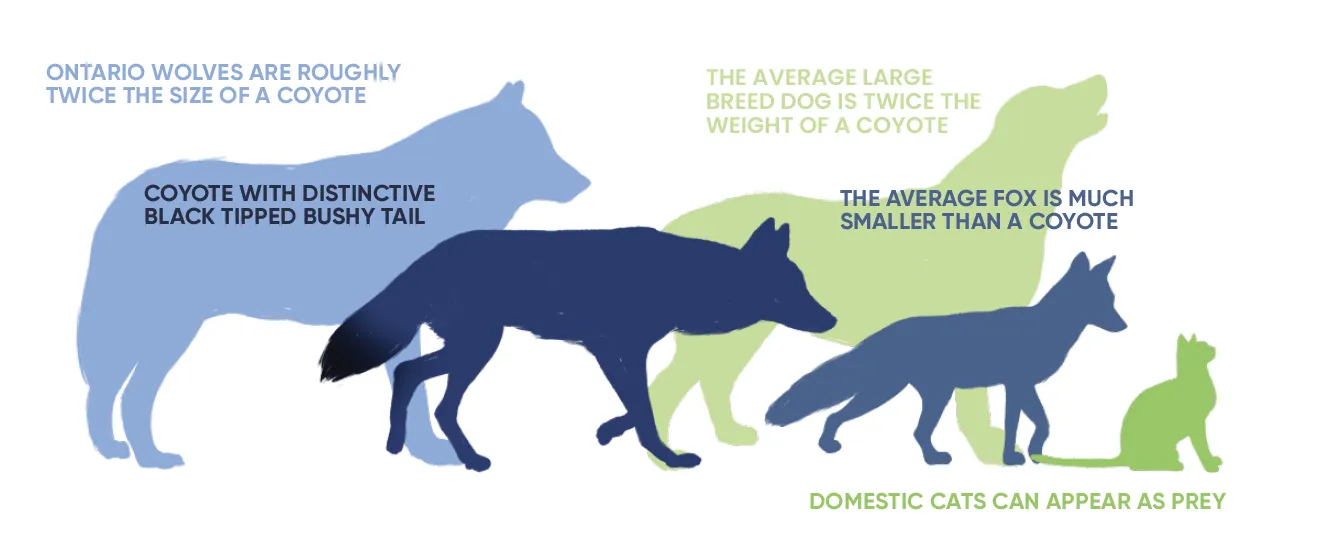
FACT: Statistically, coyotes are not a significant threat to the safety of humans. Coyote bites to humans are very rare.
FACT: Coyotes in Eastern Canada have some wolf DNA and this has been the case for many decades. A “Coywolf” does not exist – it’s just a nickname. Coyotes in Halton Hills are the same coyotes that have always been here.
FACT: Coyotes are crepuscular, meaning they’re generally most active at dawn and dusk. However, coyotes are also opportunistic which means they will pursue a food source when the opportunity presents itself. Though sickly or rabid animals will often behave abnormally, simply being out during the day is not confirmation enough that there is something wrong.
FACT: Coyotes are not a significant predator of cats. Urban coyote diet studies show that they generally eat small rodents, fruit, insects and animals that were already dead. However, coyotes occasionally hunt cats, so take safety precautions.
Additional Resources
Coyote Watch Canada:
Ministry of Natural Resources and Forestry: